
If you’ve ever looked into sustainability or commercial waste management, you’ve probably come across the term Waste Hierarchy.
But what does it actually mean, and why is it so important?
The Waste Hierarchy isn’t just an environmental concept, it’s a framework that businesses are expected to consider when making decisions about how their waste is managed. The principle is simple: keep waste as high up the hierarchy as possible to maximise resource efficiency, minimise environmental impact and reduce reliance on disposal.
Let’s break it down…

The Waste Hierarchy
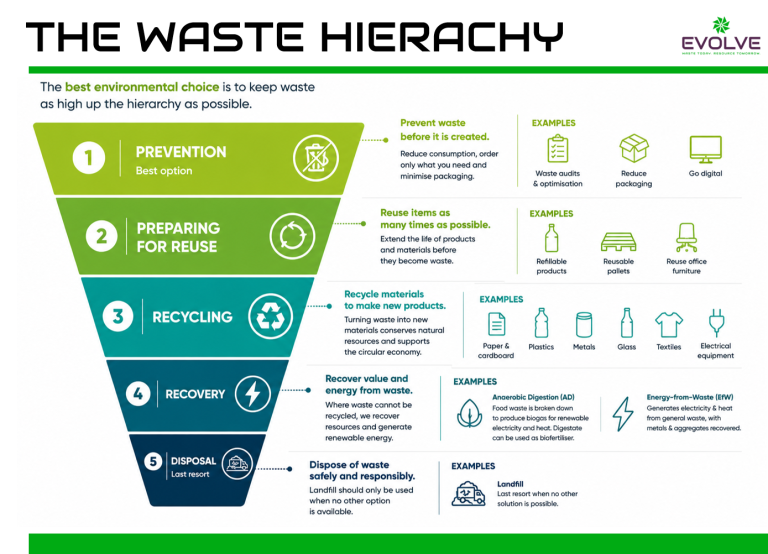
The Waste Hierarchy consists of five stages, ranked from the most environmentally beneficial option to the least.
- Prevention (Best Option)
The best waste is the waste that never exists.
Businesses can prevent waste by:
- Ordering only what they need.
- Reducing unnecessary packaging.
- Moving to digital documentation.
- Reusing office furniture and equipment.
- Improving stock management to reduce food waste.
Preventing waste not only benefits the environment, it often saves money too.
- Preparing for Reuse
If an item can be used again, it should be.
Examples include:
- Refillable water bottles.
- Reusable pallets.
- Office furniture.
- Storage containers.
- Packaging materials.
Extending the life of products reduces demand for new raw materials and helps minimise waste.
- Recycling
When waste can’t be prevented or reused, recycling is the next best option.
Many everyday materials can be recycled, including:
- Paper and cardboard
- Plastics
- Metals
- Glass
- Textiles
- Electrical equipment
Recycling transforms waste materials into new products, reducing the need for virgin raw materials, conserving natural resources and supporting the circular economy.
- Recovery
Some waste cannot be reused or recycled, but it can still provide significant environmental value.
Recovery includes processes that generate useful resources from waste, such as renewable energy, heat or secondary materials.
Examples include:
- Anaerobic Digestion (AD) – Food waste is broken down naturally in oxygen-free tanks to produce biogas, which is used to generate renewable electricity and heat. The remaining digestate can also be used as a biofertiliser.
- Energy-from-Waste (EfW) – General waste that cannot be recycled is used to generate electricity and heat, with metals recovered from the incineration ash for recycling and the remaining ash often recycled into construction aggregates.
Recovery ensures that waste still delivers environmental value when prevention, reuse and recycling are no longer possible, helping to reduce reliance on landfill.
- Disposal (Last Resort)
Landfill should always be the final option.
Disposal should only be considered when no better treatment option exists. Sending waste to landfill wastes valuable resources and contributes to greenhouse gas emissions.
Modern waste management aims to minimise disposal by prioritising prevention, reuse, recycling and recovery wherever possible.
Why Does the Waste Hierarchy Matter?
Following the Waste Hierarchy helps businesses:
- Reduce waste management costs
- Improve recycling rates
- Reduce carbon emissions
- Comply with environmental legislation
- Demonstrate their sustainability credentials
- Make better use of valuable resources
It’s not just better for the environment, it often makes good business sense too.
💡 Did You Know?
The introduction of the Simpler Recycling legislation means businesses are now expected to separate key recyclable materials, helping to move more waste higher up the Waste Hierarchy.
By improving waste segregation, businesses can recycle more, recover more value from unavoidable waste and significantly reduce the amount sent for disposal.
How Evolve Supports the Waste Hierarchy
At Evolve, the Waste Hierarchy sits at the heart of everything we do.
Our aim is always to help customers move waste as high up the hierarchy as possible, preventing waste where we can, maximising recycling opportunities and recovering value from any remaining waste through processes such as Anaerobic Digestion and Energy-from-Waste. We do not send any waste we collect to landfill.
The Bottom Line
The Waste Hierarchy isn’t just about recycling, it’s about making the best environmental choice at every stage of the waste management process.
By preventing waste where possible, reusing materials, recycling valuable resources and recovering energy from unavoidable waste, businesses can reduce costs, improve sustainability and meet their environmental responsibilities.
With the right waste management partner, following the Waste Hierarchy becomes a practical way to improve both environmental performance and operational efficiency.
Need Some Advice?
Whether you’re looking to improve recycling rates, reduce waste management costs or build a more sustainable waste strategy, our experienced team is here to help.
At Evolve, we support businesses of every size, from independent SMEs to national multi-site organisations and blue-chip companies, providing tailored zero-to-landfill waste management solutions backed by one of the UK’s newest waste collection fleets, industry-leading reporting and exceptional customer service.
Get in touch with the Evolve team today
📞 03330 477 077